The Challenge: A Disjointed and Costly Transition of Care
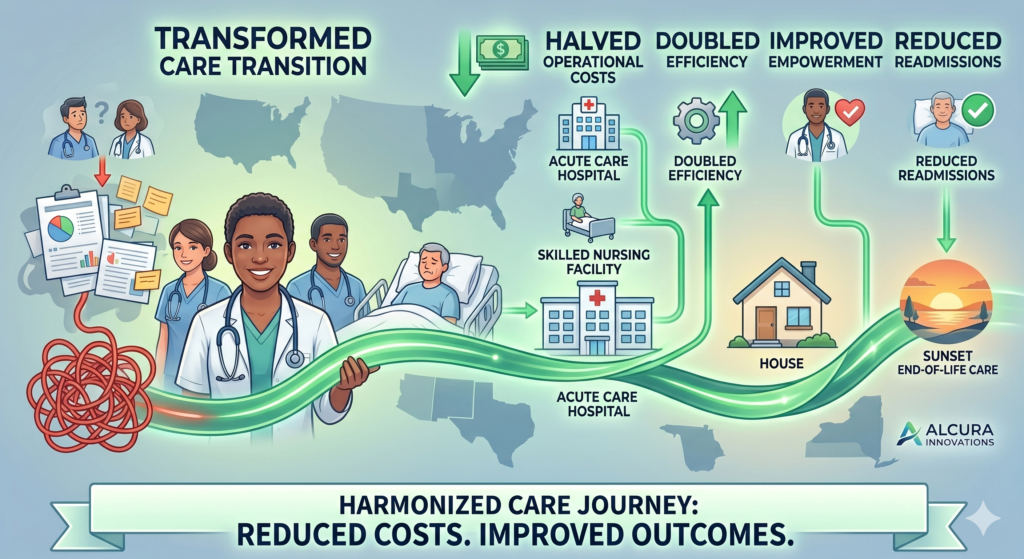
Our client, a multi-state case management company in the US, serves a large, dynamic patient population requiring seamless care coordination. With hundreds of daily patient inflows and outflows across a wide spectrum of healthcare facilities—including acute care hospitals, nursing homes, home health agencies, and end-of-life care—the transition process was inherently complex.
Ensuring that crucial patient information transferred with precision and speed from one facility to another became a significant operational bottleneck. The manual or fragmented systems in place led to:
- Increased administrative burden on clinical staff, taking time away from direct patient care.
- Risk of inaccurate or delayed care transitions.
- Skyrocketing operational costs.
Initially, the organization explored an automated solution using AI to address these challenges. However, the combination of a moderate-to-high patient load and the soaring costs of AI technology made this path non-viable. They needed a more sustainable and effective approach to operational efficiency.
The Alcura Innovations Solution: Strategic Process Optimization
Alcura Innovations was engaged to overhaul and optimize the entire care transition workflow. Rather than implementing an expensive technology overlay, we focused on the underlying processes.
Our team conducted a deep-dive workflow analysis, utilizing Value Stream Mapping (VSM) to visualize the entire patient journey. This allowed us to:
- Identify Bottlenecks: We pinpointed precisely where delays and information breakdowns were occurring in the chain of care.
- Eliminate Non-Value-Added Steps: We removed redundant administrative tasks and bureaucratic hurdles that did not contribute to patient health.
- Optimize Workflows: By restructuring and standardizing the steps involved in patient transitions, we designed a lean, reliable, and reproducible workflow.
This approach was not dependent on high-cost AI, making it both fiscally responsible and highly sustainable.
The Results: Dramatic Efficiency Gains and Improved Outcomes
The impact of this process-centric transformation was immediate and profound. Our optimization strategies helped the case management company achieve:
- Operational Costs Reduced by ~50%: Eliminating process waste and improving resource allocation slashed operational expenditure almost in half.
- Operational Efficiency Doubled: The optimized workflow enabled the organization to handle their existing patient load faster and with greater accuracy.
- Reduced Administrative Burden on Clinicians: Case managers were relieved of extensive administrative tasks,allowing them to redirect their clinical expertise back to quality patient interaction and case management.
The strategic results of this increased focus on high-quality case management were clear:
- Significant Reduction in Readmissions: Accurate, timely care coordination ensured patient needs were met at each facility, reducing the likelihood of complications and subsequent hospital readmissions.
- Improved Patient Satisfaction: A seamless and stress-free transition process drastically improved the patient and family experience.
- Enhanced Cash Flow: Reduced readmissions, combined with lower operational costs and optimized resource utilization, significantly strengthened the company’s bottom line and cash flow.
Supporting Visual: Achieving Operational Excellence
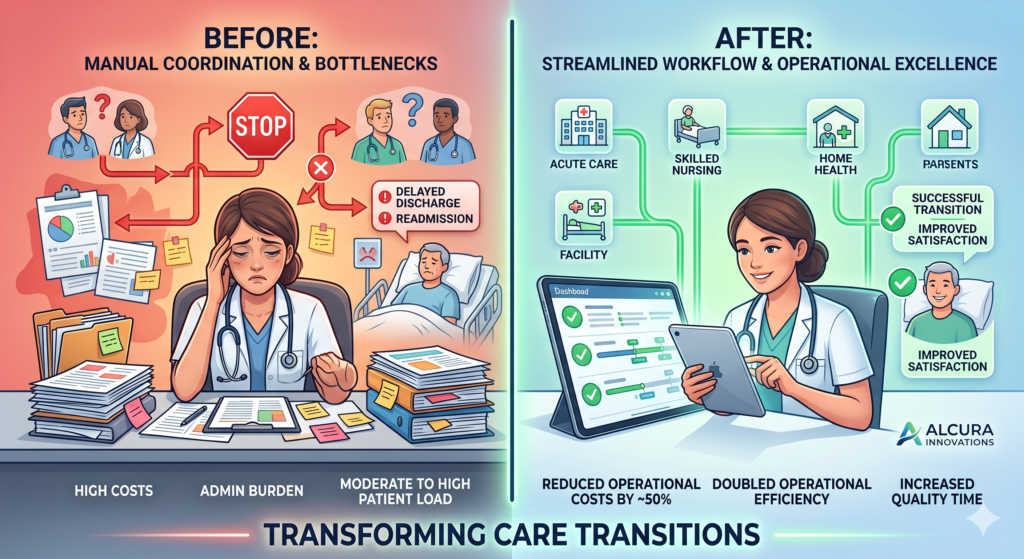
This image contrasts the fragmented, manual state of care transitions with the streamlined, optimized workflow achieved through Alcura Innovations’ workflow analysis and value stream mapping.
Image Key:
- Before (Manual Coordination): Highlights a congested workflow with high administrative burden, leading to delays, high costs, and fragmented patient information.
- After (Streamlined Workflow): Shows the optimized state with automated data flow, clear milestones, and professional case managers. It highlights the quantifiable outcomes: a ~50% reduction in operational costs, doubled operational efficiency, and decreased administrative burden, resulting in improved patient satisfaction and reduced readmissions.
Great content! Keep up the good work!